





|
The
civil war revolves around a
number of issues, particularly:
- The
end of the 30-year presidency of Félix
Houphouët-Boigny
forced the nation to grapple with the democratic process for the first
time. Houphouët-Boigny had been president for the 33 years since
independence, and so the nation's political system was bound tightly to
his myth, charisma, and political and economic competence. The
political system was forced to deal with open, competitive elections
without Houphouët-Boigny for the first time in 1995.
- The
large number of foreigners in Côte d'Ivoire, and Ivorians of
somewhat recent foreign descent, created an important issue of voting
rights. 26% of the population was of foreign origin, particularly from Burkina
Faso, a
poorer country to the north. Many of these had been Ivorian citizens
for 2 generations or more, and some of them, of Mandinka
heritage, can be considered native to the northern part of what is now
known as Côte d'Ivoire. These ethnic
tensions had
been suppressed under the strong leadership of Houphouët-Boigny,
but surfaced after his passing. The term Ivoirity,
originally coined by Henri
Konan Bédié to
denote the common cultural identity of all those living in
Côte d'Ivoire came to be used by nationalist and xenophobic
politics and press to represent solely the population of the
southeastern portion of the country, particularly Abidjan.
- Discrimination
toward people of Burkinabé
origin made neighbor countries, particularly Burkina Faso, fear a
massive migration of refugees.
- An
economic downturn due to a deterioration of the terms of trade between Third
World and developed
countries
worsened conditions, exacerbating the underlying cultural and political
issues.
- Unemployment
forced a part of the urban population to return to the fields, which
they discovered had been exploited by immigrants.
·
Violence was turned
initially against African
foreigners. The prosperity of the Côte d'Ivoire had attracted
many Africans
from West Africa, and by 1998 they constituted 26% of the population,
56% of
whom were Burkinabés.
·
In this atmosphere of
increasing racial tension,
Houphouët-Boigny's policy of granting nationality to
Burkinabés resident in
Côte d'Ivoire was criticized as being solely to gain their
political support.
·
In 1995, the tensions
turned violent when
Burkinabés were killed in plantations at Tabou,
during racial
riots.
·
Ethnic violence had
already existed between
owners of lands and theirs hosts particularly in the west side of the
country,
between Bete and Baoule, Bete and Lobi. Since independence, people from
the
center of the country, Baoules, have been encouraged to move to fertile
lands
of the west and south-west of the country where they have been granted
superficialities to grow cocoa, coffee and comestibles. Years later,
some Bete
have come to resent these successful farmers. Voting became difficult
for these
immigrants as they were refused voting rights
Civil
war
In
the early hours of September 19,
2002 troops, many of whom originated from the north of the country,
mutinied.
They launched attacks in many cities, including Abidjan. By midday they
had
control of the north of the country. Their principal claim relates to
the
definition of who is a citizen of Ivory Coast (and so who can stand for
election as President), voting rights and their representation in
government in Abidjan.
On the first night of the uprising, former president Robert Guéi
was killed.
There is some dispute as to what actually happened that night. The
government
said he had died leading a coup attempt, and state television showed
pictures
of his body in the street. However, it was widely claimed that his body
had
been moved after his death and that he had actually been murdered at
his home
along with fifteen other people. Alassane Ouattara took refuge in the
French
embassy, and his home was burned down.
The
events in Abidjan show that it
is not a tribal issue, but a crisis of transition from a dictatorship
to a
democracy, with the clashes inherent in the definition of citizenship.
Forces
involved in the conflict
include:
- Official
government forces, the National Army (FANCI), also called loyalists,
formed and equipped essentially since 2003
- The Young
Patriots: nationalist
groups aligned with President Laurent
Gbagbo
- Mercenaries
recruited by president Gbagbo:
- Belarusians
(allegedly)
- Former
combatants of Liberia,
including under-17 youths, forming the so-called "Lima militia" [1]
- New
Forces (Forces
Nouvelles,
FN), ex-northern rebels, who hold 60% of the country
- French
military
forces: Troops sent within the framework of Operation Unicorn and under
UN mandate (UNOCI),
3000 men in February 2003 and 4600 in November 2004;
- Soldiers
of the CEDEAO, White helmets, also under the UN.
The
rebels were immediately well
armed, not least because to begin with most were serving soldiers; it
has been
claimed that they were also given support by Burkina Faso.
Additionally,
government supporters claimed that the rebels were supported by France;
however, the rebels also denounced
France as supporting the government, and the French forces quickly
moved
between the two sides to stop the rebels from mounting new attacks on
the
south. It was later claimed that the rebellion was planned in Burkina
Faso by
soldiers of the Ivory Coast close to General Guéï. Guillaume
Soro,
leader of the Patriotic
Movement of Côte d'Ivoire
(MPCI) later to be known as the Forces
Nouvelles de Côte d'Ivoire/New Forces
– the rebel movement– comes from a student
union
close to the FPI of Gbagbo, but was also a substitute for an RDR
candidate in
the legislative elections of 2000. Louis Dacoury Tabley was also one of
the
leaders of the FPI.
Once
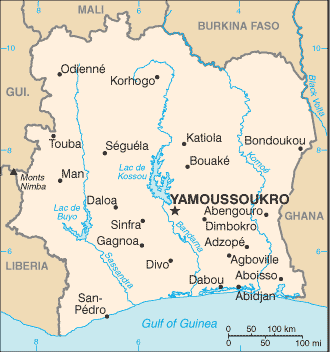
they had regrouped in Bouake,
the rebels quickly threatened to move southwards to attack Abidjan
again.
France deployed the troops it had based in Ivory Coast, on September
22, and
blocked the rebels' path. The French said they had acted to protect
their
nationals and other foreigners, and they went into the northern cities
to bring
out expatriates from many nations. The USA gave
(limited) support.
On
October 17, a cease-fire
was signed, and negotiations started.
On
November 28, the popular Movement
of the Ivory Coast of the Great West
(MPIGO) and the Movement
for Justice and Peace
(MJP), two new rebel movements, took the control of the towns of Man and Danané,
both located in the west of the country. France conducted negotiations.
French
troops dispatched to evacuate foreigners battled rebels near Man on
November
30. The clashes left at least ten rebels dead and one French soldier
injured.[4]
The
cease-fire nearly collapsed on
January 6 when two groups of rebels attacked French positions near the
town of
Duékoué, injuring nine soldiers, one of them seriously.
According to a French
spokesman, French forces repelled the assault and counterattacked,
killing 30
rebels.[5]
September 2002
Attacks were launched almost simultaneously in most
major cities; the
government forces maintained control of Abidjan and the south, but the
new
rebel forces had taken the north and based themselves in Bouake.
Laurent Gbagbo considered deserters from the army,
supported by interference
from Burkina Faso, as the cause of destabilization. The principal
difference in
interpretation related to defence. The consequence is that Paris wished
for
reconciliation, when the Côte d'Ivoire government wanted military
repression.
Paris sent 2500 soldiers to man a peace line and
requested help from the United
Nations.
[edit] The
Kléber (Marcoussis)
agreements
To bring parties together, the parties signed a
compromise at Linas-Marcoussis
on January 26 [2].
President Gbagbo was to retain power and opponents were invited into a
government of reconciliation and obtained the Ministries for Defense
and the
Interior. Soldiers of the CEDEAO and 4000 French soldiers were placed
between
the belligerents - a peace line. The parties agreed to work
together on
modifying national identity, eligibility for citizenship, and land
tenure laws
which many observers see as among the root causes of the conflict.
As of February 4, anti-French demonstrations took place
in Abidjan, in
support for Laurent Gbagbo. The end of the civil war was proclaimed on
July 4.
An attempt at a putsch,
organized from France by Ibrahim Coulibaly (FPI), was thwarted on
August 25 by
the French secret service.
The UN authorized the formation of the UNOCI on February
27, 2004, in addition to the French forces and those of the CEDEAO.
On March 4, the PDCI suspended its participation in the
government, being in
dissension with the FPI (President Gbagbo's party) on nominations to
office
within the administration and in public companies.
On March 25, a peace march was organized to protest
against the blocking of
the Marcoussis agreements. Demonstrations had been prohibited by decree
since
March 18, and the march was repressed by the armed forces: 37 died
according to
the government, between 300 and 500 according to Henri Konan
Bédié's PDCI. This
repression caused the withdrawal from the government of several
opposition
parties. A UN report of May 3 estimated at least 120 dead, and
implicated
highly-placed government officials.
The government of national reconciliation, initially
composed of 44 members,
was reduced to 15 after the dismissal of three ministers, amongst them Guillaume
Soro, political head of the rebels, on May 6. That involved the
suspension
of the participation in the national government of the majority of
political
movements.
The French consequently were in an increasingly
uncomfortable situation. The
two sides each accused France of siding with the other: the loyalists
because
of its protection of the rebels, and the non-implementation the
agreements of
defense made with the Côte d'Ivoire; the rebels because it was
preventing the
capture of Abidjan. On June 25, a French soldier was killed in his
vehicle by a
government soldier close to Yamoussoukro.
On July 4, 2003, the government and New Forces
militaries signed an
"End of the War" declaration, recognized President Gbagbo's
authority, and vowed to work for the implementation of the LMA and a
program of
Demobilization, Disarmament and Reintegration (DDR).
In 2004, various challenges to the Linas-Marcoussis
Accord occurred. Violent
flare-ups and political deadlock in the spring and summer led to the
Accra III
talks in Ghana.
Signed on July 30, 2004 the Accra III Agreement reaffirmed the goals of
the LMA
with specific deadlines and benchmarks for progress. Unfortunately,
those
deadlines – late September for legislative reform and October 15
for rebel
disarmament – were not met by the parties. The ensuing political
and military
deadlock was not broken until November 4, 2004.
The
resumption of fighting
But the timetable was not respected. The bills envisaged
in the process were
blocked by the FPI, the Ivorian National Assembly. The conditions of
eligibility for the presidential poll were not re-examined, because
Laurent
Gbagbo claimed the right to choose a prime minister, not in accordance
with
agreements suggested in Accra. Faced with political impasse,
the
disarmament whose beginning had been envisaged fifteen days after the
constitutional modifications did not begin in mid-October.
A sustained assault on the press followed, with
newspapers partial to the
north being banned and two presses destroyed. Dissenting radio stations
were
silenced.
UN soldiers opened fire on hostile demonstrators taking
issue with the
disarmament of the rebels on October 11. The rebels, who took the name
of New
Forces (FN), announced on October 13 their refusal to disarm,
citing large
weapons purchases by the Côte d'Ivoire national army (FANCI).
They intercepted
two trucks of the FANCI full of heavy weapons travelling towards the
demarcation line. On October 28, they declared an emergency in the
north of the
country.
Ivorian-French
violence
Main article: Ivorian-French violence, 2004
On November 4, the new FANCI planes, apparently manned
by Belarusian
mercenaries,
began a bombardment of Bouaké.
On November 6, FANCI planes bombed a French base in
Bouaké, supposedly by accident, killing nine French soldiers and
an American
aid worker and injuring 39 others. The French forces responded by
destroying
both Sukhoï
fighter-bombers based at Yamoussoukro. Jacques
Chirac gave the order to destroy five other Mi-24
helicopters.
One hour after the attack on the camp, French forces established
control of the
airport of Abidjan. Simultaneously, the Young Patriots
of Abidjan
(see politics of Côte d'Ivoire
for more
details), rallied by the State media, plundered possessions of French
nationals. Rapes, beatings, and murders followed. Several hundred
Westerners,
mainly French, took refuge on the roofs of their buildings to escape
the mob,
and were then evacuated by helicopters of the French Army. France sent
in
reinforcements of 600 men based in Gabon and France
while foreign civilians were evacuated from Abidjan
airport on French and Spanish military airplanes
As of
November 8, 2004, expatriate
Westerners (French mainly, but also Moroccan, German, Spanish, British,
Dutch,
Swiss, Canadian, and Americans) in Côte d'Ivoire chose to leave.
On November
13, President of the Ivorian National Assembly Mamadou Coulibaly (FPI)
declared
that the government of the Ivory Coast did not take any responsibility
in the
bombardment of November 6, and announced its intention of approaching
the International
Court of Justice:
- for
the destruction of the Ivory Coast Air force, only recently re-equipped;
- for
activities by the French Army responsible for several deaths.
In an
interview with The
Washington Post, Laurent Gbagbo called into question even the
French
deaths. Lastly, on the morning of 13 November, 2600 expatriate French
had
returned to France, and 1600 other European expatriates had left.
The
United Nations Security Council
passed Resolution 1572 (2004) on November 15, enforcing an arms embargo
on the
parties.
A
meeting of the Ivorian political
leaders, moderated by South
African
President Thabo
Mbeki
was held in Pretoria from
April 3 to April 6, 2005. The resulting Pretoria
Agreement declared the immediate and final cessation of all hostilities
and the
end of the war throughout the national territory [3].
Rebel forces started to withdraw heavy weapons from the front line on
April 21 [4].
Presidential
elections were due to
be held on October 30, 2005, but in September the UN Secretary General,
Kofi
Annan,
announced that the planned elections could not be held in time.[6]
On October 11, 2005, an alliance of Côte d'Ivoire's main
opposition parties
called on the UN to reject African
Union
proposals to keep President Laurent
Gbagbo
in office for up to an additional 12 months beyond the end of his
mandate;[7]
however, the Security Council approved this a few days later.[8]
The Côte
d'Ivoire national football team
helped secure a truce in 2006 when it qualified for the World
Cup
and convinced Gbagbo to restart peace talks.[3]
It also helped further reduce tensions between government and rebel
forces in
2007 by playing a match in the rebel capital of Bouaké,
an occasion that brought both armies together peacefully for the first
time.[9]
In late 2006, the elections were again delayed, this time until October
2007.
On
March 4, 2007, a peace agreement
was signed between the government and the New Forces in Ouagadougou, Burkina
Faso.
New Forces leader Guillaume Soro was subsequently appointed prime
minister and
took office in early April.[10]
On April 16, in the presence of Gbagbo and Soro, the U.N. buffer zone
between
the two sides began to be dismantled, and government and New Forces
soldiers
paraded together for the first time. Gbagbo declared that the war was
over.[11]
On
May 19, the disarmament of
pro-government militia began as the Resistance Forces of the Great West
gave up
over a thousand weapons in a ceremony in Guiglo, at
which Gbagbo was present.[12]
Central
government administration
began returning to the New Forces-held areas in June, with the first
new prefect
in the north being installed on June 18 in Bouaké.[13]
On
June 29, rockets were fired at
Soro's plane at the airport in Bouaké,
significantly damaging the plane. Soro was unhurt, although four others
were
said to have been killed and ten were said to have been wounded.[14]
Gbagbo
visited the north for the
first time since the outbreak of the war for a disarmament ceremony,
the
"peace flame", on July 30; Soro was also present. This ceremony
involved burning weapons to symbolize the end of the conflict.[15][16]
It was previously planned for June 30 and then for July 5, but was
delayed.[17]
At the ceremony, Gbagbo declared the war over and said that the country
should
move quickly to elections, which were planned for 2008.[16]
On
November 27, 2007, Gbagbo and
Soro signed another agreement in Ouagadougou,
this one to hold the planned election before the end of June 2008. On
November
28, Gbagbo flew to Korhogo, then to Soro's native Ferkessedougou,
at the start of a three-day visit to the far north, the first time he
had been
to that part of the country since the outbreak of the war, marking
another step
toward reconciliation.[18]
On December 22, a disarmament process planned to take place over the
course of
three months began with government soldiers and former rebels
withdrawing from
their positions near what had been the buffer zone; the forces of the
two sides
respectively went to barracks in Yamoussoukro and Bouaké. Gbagbo
and Soro were
present at Tiebissou to
mark the event; Gbagbo said that, as a result, the front
lines of the conflict no longer existed, and Soro said that it
"effectively, concretely marks the beginning of disarmament".[19]
As of
May 18, 2005 the UN
forces,
as result of the continued flaring up of ethnic as well as
rebel-government
conflict, have experienced difficulty maintaining peace in the
supposedly neutral
"confidence zone", particularly in the west of the country. UN troops
have been deployed laterally, forming a belt across the middle of
Côte d'Ivoire
(stretching across the whole country and roughly dividing it in two
from north
to south). This area has a mixture of ethnic
groups,
notably the Dioula
(who are predominantly Muslim and
typically aligned with the New Forces), who
typically sway to both government and rebel loyalties. This conflict of
interests has created widespread looting, pillaging and various other human
rights
abuses amongst groups based on the typical political alignment of their
ethnicities. A total of 25 UN personnel have died during UNOCI.
In
2005, over 1,000 protesters invaded
a UN base in Guiglo
and took control but were forced back by armed UN peace keepers. A
total of 100
protesters died and left 1 UN peace keeper dead and another wounded.
This
is not to say that there are no
regions where ethnic groups co-exist peacefully, however, the UN troops
lack
the man-power to prevent inter-ethnic violence. [5]
On
July 21, 2007 the UNOCI
suspended a Moroccan peacekeeping
unit in Ivory Coast following an investigation into allegations of
widespread
sexual abuse committed by U.N. peacekeepers in the nation. [6]
|